

Key takeaways
- A named beneficiary gets the benefit outside the estate.
- The insurer generally pays within 30 days of the documents.
- Payable to the estate: debts and tax come before the heirs.
- The spousal rollover can move the tax to the second death.
- Last-to-die insurance can provide that cash.
"It is much simpler to settle an estate with an insurance amount than to remortgage your buildings or force the estate to sell."
Alexandre often meets people who believe their debts disappear when they die. The debts remain, and tax on certain property is added on top.
Well-chosen life insurance can help solve the problem. It still has to reach the right person, at the right time.
In short: in Quebec, life insurance payable to a named person is not part of the estate. It is generally paid within 30 days of receiving the supporting documents, without waiting for the estate to be settled. Properly structured and in a sufficient amount, it can be used to pay the tax at death, which reduces the risk that your heirs have to sell property.
Is life insurance part of the estate in Quebec?
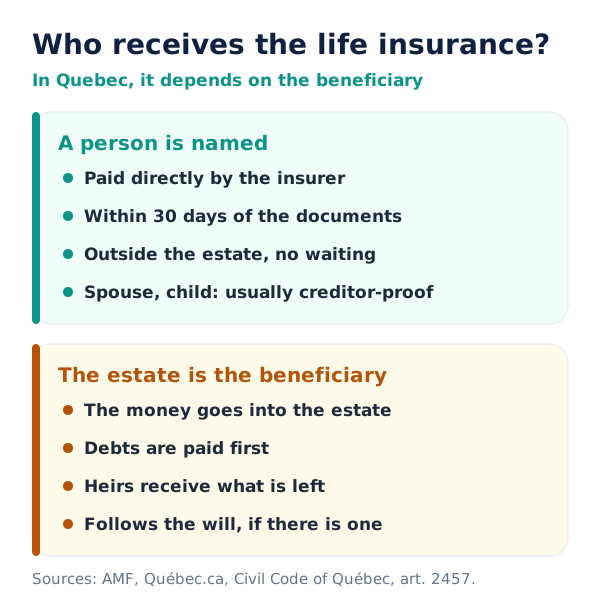
Not if a beneficiary is named. According to Québec.ca, the benefit is paid to the named beneficiary, regardless of whether the succession is accepted.
Yes, if the policy is payable to "the estate", the "heirs", the "liquidators" or the "legal representatives". The benefit then goes into the estate, like any other property.
When no beneficiary is named, Éducaloi explains that the benefit goes to the policyholder, meaning the person who owns the contract, or to their heirs. So you need to check who owns the contract.
If you are both the insured and the policyholder, which is common, the benefit then goes into your estate.
A point to watch after a separation: naming a former married or civil union spouse lapses on divorce or dissolution of the civil union, according to Québec.ca. With no other beneficiary, the benefit goes to the policyholder or their estate.
A person or the estate: what is the goal?
The two choices do not serve the same purpose. Naming a person protects that person. Naming the estate gives the liquidator cash.
In both cases, the insurer pays the same way. The AMF states that it must pay the amount within 30 days of receiving the supporting documents. An incomplete or disputed claim can take longer.
The difference comes afterward. When the estate receives the benefit, it goes first to debts and tax. The heirs receive the balance once the estate is settled.
That has no fixed timeline. The Chambre des notaires notes that the liquidator must obtain the federal clearance certificate and the Revenu Québec certificate before distributing the property.
The Canada Revenue Agency is clear: a liquidator who distributes without that certificate becomes personally liable for unpaid tax, up to the value of the property distributed.
| Named beneficiary | The estate | |
|---|---|---|
| Who receives the benefit | The named person | The liquidator, for the estate |
| Who decides how it is used | The beneficiary | The liquidator, according to the will |
| Can pay tax and debts | Only if the beneficiary chooses to | Yes, before distribution |
| When the heirs benefit | As soon as it is paid | After the estate is settled |
A point often overlooked: the liquidator has no right to a benefit paid to a named person. If you are counting on this insurance to pay the estate's tax, coordinate the designation with your will and have your notary review it.
Is life insurance protected from creditors?
Often, yes, depending on who the beneficiary is and on your situation. Article 2457 of the Civil Code of Québec covers the case where the beneficiary is the policyholder's married or civil union spouse, descendant or ascendant.
In that case, the rights under the contract cannot be seized until the beneficiary has received the insured amount.
An irrevocable designation can also make those rights exempt from seizure, for as long as it stands (article 2458). It comes with a trade-off: Éducaloi notes that you then need the beneficiary's permission to change it.
Naming a married or civil union spouse, other than in a will, is irrevocable unless the contract states otherwise.
These articles refer to married and civil union spouses. For a de facto (common-law) spouse, including in a parental union, have your notary confirm which rights are protected, against which creditors and until when.
Common-law spouse: life insurance matters even more
Without a will, a common-law spouse who is not in a parental union is not a legal heir in Quebec, according to Québec.ca and Éducaloi (in French).
The parental union changes this for some couples. According to Québec.ca (in French), it applies to common-law spouses who live together, present themselves publicly as a couple and have a child together born or adopted on or after June 30, 2025.
Parents of a child born before that date can opt in voluntarily, by notarial deed or by a written contract signed before two witnesses. Éducaloi (in French) explains that in a parental union, the surviving spouse can receive a share of the estate without a will, under certain conditions. Check your situation with your notary.
Life insurance that names your spouse as beneficiary pays them a benefit outside the estate, even without a will. It is often a simple way to protect them.
A will is still needed for the rest of your property. The two work together.
What tax will your estate have to pay?
At death, a person is deemed to have disposed of their capital property at fair market value right before dying, according to the CRA and section 70 of the Income Tax Act. The resulting capital gain is reported on the final return.
RRSPs and RRIFs follow their own rules, described by the CRA.
| Property | General rule, before any available rollovers and exemptions |
|---|---|
| Principal residence | Gain exempt, in whole or in part |
| Cottage, land | Half of the capital gain is taxable |
| Rental property | Half of the capital gain is taxable; recapture of capital cost allowance may also be added to income |
| Non-registered investments | Half of the capital gain is taxable |
| RRSP or RRIF | The full value is added to income, unless there is an eligible transfer, for example to the spouse |
| Shares of a business | Half of the gain; an exemption may apply to certain qualifying shares |
The taxable gain is not the tax. The tax then depends on the other income for the year of death and the applicable rates. Calculating it is the job of your accountant or tax specialist.
In 2026, half of a capital gain is taxable. The increase announced in 2024 was cancelled by the federal government in March 2025, then by Quebec (in French) in November 2025.
For a step-by-step example on a cottage, see our article term or permanent life insurance.

Rental property often weighs heavily. On top of the capital gain, the CRA states that the deemed disposition can result in a recapture of the capital cost allowance claimed over the years, or instead a terminal loss. Have your accountant confirm the calculation.
If you own a business with partners, see also our article on the shareholders' agreement.
The couple's trap: the tax can come at the second death
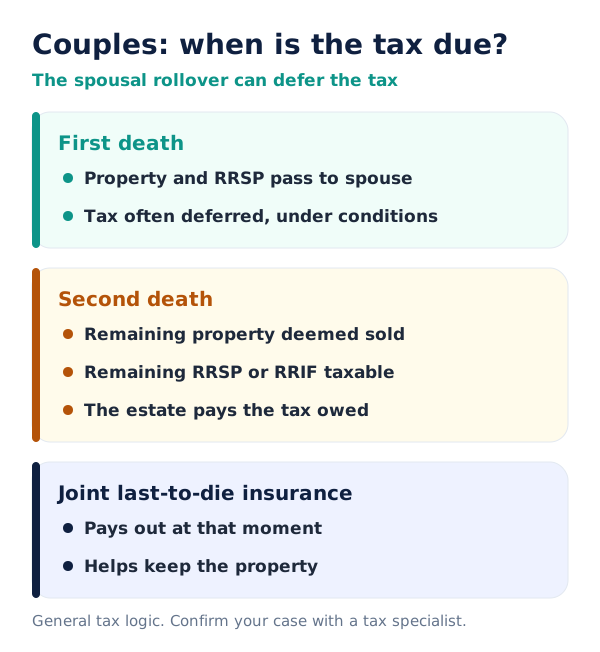
Capital property left to a surviving spouse, including a common-law partner, can benefit from a rollover. This rollover is not automatic in every case: it has conditions, for example on residence in Canada and a 36-month deadline for the property to vest in the spouse. The liquidator can also choose not to apply it.
An RRSP can also be transferred to the spouse, under the rules for registered plans.
Éducaloi (in French) sums it up: the tax is deferred until your spouse sells or gives away the property. It is not cancelled.
Two scenarios are possible:
- The spouse keeps the propertyWhen the rollover conditions are met, the deferred tax on the cottage, investments and RRSP can become payable on their final return, at their death.
- The spouse sells or withdraws firstIf they sell the cottage or withdraw money from the RRSP during their lifetime, the tax is paid at that point, not at the second death.
Joint last-to-die life insurance
It covers two people and pays out at the death of the second. According to Sun Life, it is generally used to pay final taxes and estate costs, and to leave an inheritance.
Premiums for last-to-die coverage are often lower than for first-to-die coverage, for the same amount. Alexandre gives you the exact comparison for your situation.
| Joint insurance | When it pays | What it is for |
|---|---|---|
| First-to-die | At the death of the first of the two | Protect the surviving spouse |
| Last-to-die | At the death of the second | Provide cash for the deferred tax and leave an estate |
That is the need created by the spousal rollover. If a lasting cash shortfall is established, permanent insurance can be considered. The choice also depends on available assets, existing coverage and your budget.

How much insurance to pay the tax at death?
Start with a list of your property, its estimated value and its adjusted cost base. For capital property, the gap between the two helps estimate the potential gain.
Your accountant then has to calculate the tax, taking into account your other income and the rules for each type of property. This method does not apply as is to RRSPs or to recapture of depreciation.
Add the debts that will remain: mortgage, line of credit, loans. They add up with the tax, and people often forget that.
From these figures, you can calculate the amount of insurance that would cover the need. Only subtract the cash and insurance that are actually available for this need. The need can go up or down with your property, your debts, your cash and your existing coverage. A periodic review lets you check whether the coverage still fits.
To prepare for the meeting, gather:
- for each policy: the policyholder, the insured, the beneficiaries and whether they are revocable or irrevocable;
- the insured amount of each policy;
- your debts and their balances;
- your property and the cash available.
Review it with Alexandre

Alexandre Garneau, financial security advisor (AMF certificate no. 272275) representing iA Financial Group, reviews with you:
- who is named as beneficiary on each of your policies, and whether that is still the right choice;
- the property that will create tax at death, so your accountant can estimate the amount;
- the amount and type of insurance that could cover that need, including joint last-to-die coverage.
He can work with your notary on the will and with your accountant on taxes, with your consent. He does not replace either of them.
The review meeting is free and with no obligation. It may lead to an insurance proposal. If you buy a policy, Alexandre is paid a commission by the insurer, and he explains this before any proposal.
To go further, see our permanent life insurance and personal insurance pages.
This article provides general information. It is not tax, legal or financial advice tailored to your situation. The rules cited were in force at the time of writing. For your own case, consult a notary and a tax specialist or accountant.