

Key takeaways
- Term: a need with an end date.
- Permanent: a lifelong need, like taxes at death.
- Many term policies can become permanent, up to an age limit.
- Your debts don't disappear when you die.
- Employer coverage usually ends when the job does.
"Many people believe their debts disappear at death, or that group insurance will cover all their needs over the long term."
It's one of the first questions people ask when shopping for life insurance: term or permanent life insurance, which one should you choose?
In short: term insurance protects a need with an end date, like the mortgage or dependent children. Permanent insurance protects a need that will exist no matter when you die, like taxes at death. Many families need both.
The choice has consequences. According to LIMRA (2023 Canadian Insurance Barometer), 31% of Canadian adults say they need life insurance, or more of it.
In the same study, 4 in 10 Canadians say their family would face financial hardship within six months of the main breadwinner's death.
Term vs permanent life insurance: the difference at a glance
Term insurance costs less and covers a fixed period. Permanent insurance costs more, but it's designed to last your whole life, subject to the terms of the contract.
| Term life insurance | Permanent life insurance | |
|---|---|---|
| Length of coverage | 10, 20 or 30 years, depending on the contract | Your whole life, according to the terms of the contract |
| Initial cost | Lower | Higher |
| Premium at renewal | Recalculated based on your age, much higher | Set in the contract, depending on the policy type |
| Cash value | None | Possible depending on the contract (participating or non-participating whole life, universal); generally none with T100 |
| Typical need | Mortgage, dependent children, income to replace | Taxes at death, estate, real estate, inheritance |
| Watch out for | Ends at expiry, unless renewed or converted | Long-term premiums; dividends and returns that vary and can go down |
Who is term life insurance for?
Term life insurance suits people who want a large amount of coverage at a lower cost. It covers the years when your death would hit your family hardest.
Think of a mortgage to pay off, children to raise or an income your family depends on.
The death benefit is not taxable for your beneficiaries. When paid to a designated beneficiary, it also bypasses the estate.
Two clauses to check in your contract:
- RenewalAt the end of the term, the policy generally renews, but at a premium recalculated based on your age.
- ConversionMany term policies can be converted to permanent coverage without new medical evidence. This privilege ends at an age limit set in the contract. Check that age in your policy.
Who is permanent life insurance for?
Permanent life insurance suits needs that don't retire. Think of taxes at death, passing on a cottage or a building, or leaving an inheritance.
It's designed to protect you for your whole life, subject to the terms of the contract. It comes in several forms:
- T100term to 100, permanent coverage with a level premium, generally without cash value.
- Whole lifeparticipating or non-participating. Participating whole life builds cash value, which dividends may add to. Dividends are not locked in ahead of time: the insurer can reduce them based on its results. Keep them separate from the values fixed by the contract.
- Universal lifeprotection and savings combined, with tax-sheltered growth within the limits allowed by law.
With universal life, the cost of coverage and fees are deducted from the policy's accounts every month, as this Co-operators guide (in French) explains. What you pay in must stay high enough to keep the policy in force.
Do your debts disappear when you die?
No. In Quebec, the estate pays the debts before the heirs receive anything. The mortgage, the line of credit and loans come first.
It's a belief Alexandre regularly corrects in meetings.

Éducaloi (in French) sets out the order: debts first, then bequests and the other heirs.
As a rule, an heir doesn't have to pay more than the value of what they receive. But this protection only applies if the liquidation rules are followed. Otherwise, Éducaloi warns, the heir may have to pay the debts out of their own pocket.
It doesn't cover someone who co-signed a loan with you either: that person is still required to repay it.
And even when the rules are followed, debts can eat up a large part of what you wanted to leave.
Quebec adds a layer of protection. When the designated beneficiary is your married or civil union spouse, a descendant or an ascendant, the rights under the contract are exempt from seizure until the beneficiary receives the insured amount (Civil Code of Québec, art. 2457).
An irrevocable beneficiary designation also makes those rights exempt from seizure, for as long as it stands (art. 2458). Be careful: a common-law partner is not covered by article 2457.
How much tax will your estate have to pay?
At death, you are deemed to have sold your capital property at fair market value. This is called a deemed disposition. According to the Canada Revenue Agency, the gain is taxed on the final return.
This includes a cottage (if it isn't designated as your principal residence), a rental property or non-registered investments.
Your RRSP or RRIF is also added in full to your income for the final year.
The only exception, as the CRA explains: a transfer to your spouse or, under certain conditions, to a financially dependent child or grandchild.

A fictional example to show the order of magnitude
A cottage bought for $150,000 is worth $350,000 at death. The gain is $200,000.
We assume a Quebec resident, a cottage not designated as a principal residence, a purchase price equal to the tax cost and no losses to deduct.
Half of the gain is taxable: the inclusion rate remains 50%, since the proposed increase was cancelled in March 2025. That means $100,000 added to income.
The top combined marginal rate is 53.31% in 2026, according to the Chaire en fiscalité et en finances publiques (in French).
If your other taxable income is already above $258,482, the 2026 threshold for that rate, the tax on this gain comes to about $53,000. That's the tax on the cottage alone, not the whole tax bill at death.
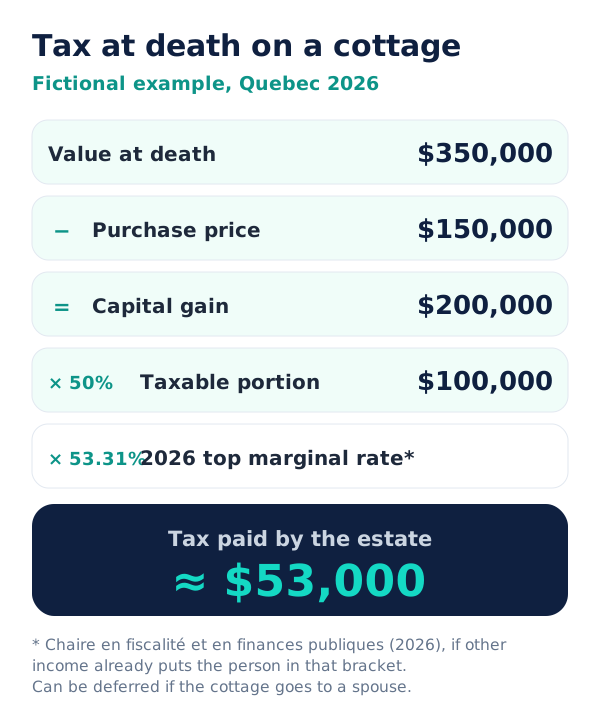
If the cottage goes to your spouse, this tax can generally be deferred. Otherwise, the estate has to pay it.
How permanent insurance can pay the taxes at death
Without cash on hand, the heirs have to remortgage or sell. And sometimes it's the very family cottage you wanted to leave them.
As Alexandre puts it, settling an estate with an insurance payout is far simpler than remortgaging your buildings or forcing the estate to sell.
This need doesn't go away with age. It grows with your assets, and permanent insurance that is in force can meet it, no matter when death occurs.
The money still has to land in the right place. The amount, the designated beneficiary and how the funds will serve the estate need to be coordinated, ideally with your notary.
Is permanent life insurance worth it?
It can be worth it for a need that will last your whole life, if the resources you've already planned aren't enough and the premiums fit your budget. Paying the tax on a cottage, a building or an RRSP, or passing on your assets without forcing a sale, are examples.
For a need with an end date, like a mortgage, term insurance generally costs less for the same amount of coverage.
You often hear that you should "avoid permanent life insurance." For some people, that's true. For others, the need lasts beyond the end of the term policy, and they have to plan how to fund it.
Alexandre doesn't believe in one right strategy for everyone. A self-employed worker, a family with young children and a business owner don't have the same needs. ## Can you combine term and permanent?
Yes. Each need has its own time frame:
- term insurance for the mortgage years and the years your children depend on you;
- a smaller permanent policy, calculated for taxes at death and the estate.
With two policies, each one can meet a specific need. That can help you avoid paying for a bigger permanent policy than you need. The right combination depends on an analysis of your situation.
Is your employer's insurance enough?
Rarely on its own. Group insurance is tied to your job, and the amount is set by the plan, for example one or two times your salary. Check your plan booklet.
Alexandre asks his clients two questions.
If you change jobs, does your coverage follow you? Generally, no. The AMF (in French) points out that group insurance usually ends with your job or at retirement.
In Quebec, however, the regulations give you a conversion right (Regulation under the Act respecting insurance, s. 62). If you leave the group before age 65, you can convert your group life insurance into individual insurance:
- within 31 days of leaving;
- without having to prove your insurability;
- for at least $10,000, up to your group coverage, with a $400,000 cap.
Your group coverage stays in force during that period, or until the day it is converted to individual insurance if that happens sooner. The premium for the new policy is based on your age at the time of conversion. Check the steps with the plan's insurer before you leave.
Do you know how much coverage you have? One or two times your salary is rarely enough to pay off a mortgage and replace an income for years.
And if you're self-employed, you generally have no group insurance at all, except through an association or a professional order.
See how Alexandre works with individuals and families who want to close that gap.
What does waiting cost you?
The longer you wait, the higher the premiums. And a health issue that appears in the meantime can lead to an extra premium, or even a refusal.
According to Alexandre, people often start thinking seriously about it when a child is born or when they buy a home.
The best time, in his view: when you're young and healthy, even if the need seems far away.

Alexandre has worked with a client (details anonymized) who had cancelled an old life insurance policy he found too expensive, without having his needs analyzed.
His health then declined. When he tried to get insured again, he couldn't get a standard rate: a higher premium for a lower amount of coverage.
Before cancelling a policy, have your needs analyzed. And if you're replacing it, the AMF (in French) advises against ending the old contract until the new one suits you and is in force.
Your health will be assessed again, and the insurer decides. An iA Financial Group health questionnaire (in French) even asks whether insurance was ever refused, modified or granted with an extra premium.
Too expensive? Start with what you want to protect
When a client finds insurance too expensive, Alexandre asks what they're really trying to protect.
Compared with the mortgage balance, the children's education or a few years of income, the monthly cost looks different.
The goal is to protect what would have the biggest financial impact on your family, without spending more than necessary.
How to choose with Alexandre
Alexandre Garneau, a financial security advisor representing iA Financial Group, starts from your real situation:
- your debts and how much time is left to repay them;
- your children's ages;
- the assets that will trigger taxes at death, like a cottage, a rental property or non-registered investments;
- your group insurance, and what happens if you change jobs;
- your budget.
To prepare for the meeting, gather your current insurance contracts, your group plan booklet and your debt balances.
From there, he works out with you whether you need term or permanent life insurance, or both, and the amount that matches each need.
The needs analysis is free, with no obligation to buy. It may lead to an insurance proposal, which you're free to decline. If you buy a policy, Alexandre is paid a commission by the insurer.
This article provides general information. It does not replace tax, legal or financial advice tailored to your situation. The terms of each policy are those set out in your contract. Alexandre Garneau holds a certificate issued by the Autorité des marchés financiers (AMF), no. 272275, and represents iA Financial Group; he also offers products from the MRa firm. His professional conduct is governed by the Chambre de l'assurance (Quebec's insurance professional body).