

Key takeaways
- No buyout clause: the heirs could become your partners.
- At death, tax on the capital gain may be payable.
- Insurance in force can fund the buyout, with no loan.
- Criss-cross, corporate or hybrid: depends on taxes.
- Review the amount yearly as the value grows.
Two partners build a business together for fifteen years. They never sign a shareholders' agreement, and never take out insurance on each other.
One of them dies. His shares go to his father, who never worked in the business. The father refuses to sell and wants a say in decisions.
Conflicts start, growth slows, contracts are put at risk. This is a scenario Alexandre Garneau uses to show what a funded agreement could have prevented (a realistic scenario, not an actual case).
In short: a shareholders' agreement sets out who buys the shares of a partner who dies, at what price and with what money. If the policy is in force and the amount is well chosen, life insurance can provide that money at death, with no loan and no asset sale.
What is a shareholders' agreement?
It is a written agreement between the owners of a business, according to Éducaloi. It sets the ground rules between partners: who decides what, and what happens to the shares when one of them leaves.
It is optional in Quebec. No law requires partners to sign one.
The clause that matters here is the buy-sell clause. Éducaloi explains that the agreement can provide that a partner's death, disability or incapacity automatically triggers the forced sale of their shares.
It can also set in advance how each share will be valued. The price is no longer negotiated at the worst possible time.
Drafting the agreement is the job of your notary or lawyer. The role of a financial security advisor is to propose the insurance that will fund its buyout clauses.
What happens when a partner dies without a funded agreement?
Their shares become part of their estate. Without an applicable buyout clause, Éducaloi warns that you risk becoming the business partner of your partner's heirs.
The company's articles or other agreements may govern that transfer. But without a buyout clause, nothing requires the estate to sell, and no price is set.
An agreement can also exist without being funded. The buyout clause then requires the purchase at the set price, but the buyer has to find the money on their own.

Death also has tax effects. The Canada Revenue Agency considers that a person sold all their property right before death, even without an actual sale.
The capital gain on the shares is reported on the deceased's final return. An exception exists for property transferred to a surviving spouse.
In 2026, half of a capital gain is generally taxable. The inclusion rate increase announced in 2024 was cancelled by the federal government in March 2025, then by Quebec (in French) in November 2025.
The tax is not automatic. It depends on the cost of the shares, available losses, a possible rollover to a spouse and, for qualified small business shares, the capital gains deduction, according to a guide from iA Financial Group (in French).
If tax is owed, the estate may be short of cash until the shares are sold. A funded agreement makes the buyout easier and gives the estate cash. It does not erase the tax.
This affects most small businesses
According to a Canadian Federation of Independent Business survey published in 2023, 76% of Canadian small business owners plan to exit their business within 10 years.
The same survey found that only 9% of them have a formal written succession plan. A funded shareholders' agreement is often the first piece of that plan.
Why fund the buyout with insurance?
Because the buyout has to be paid just as the business loses a leader. If the agreement provides for a purchase at death, the designated buyer must have the funds to pay the price set by the agreed method.
Depending on the agreement, that buyer is the surviving partner, the company, or both. The price often runs to hundreds of thousands of dollars.
| Source of funds | At death | What to know |
|---|---|---|
| Company savings | Only what has been set aside | Not enough if death comes early |
| Loan | Whatever the bank agrees to | Just as the business has lost a leader |
| Asset sale | Slow, often at a discount | Weakens the business you want to keep |
| Life insurance | The insured amount, if the policy is in force | Cost: the premium, which varies with the type of policy, your age and your health |
RBC Insurance puts it this way: owners or partners don't have to use their own funds or the business's assets to finance the buyout.
For Canada Life, insurance also spares the survivors the trouble and cost of a loan. It eases the financial pressure of the buyout. The business's other needs after losing a leader are planned separately.
The proceeds do not arrive the same day. The AMF (in French) states that the insurer must pay within 30 days of receiving the supporting documents. The agreement can set the payment dates for the price accordingly.
Three ways to structure the insurance
The setup has to coordinate the buyer of the shares, the policy owner, the beneficiaries and the path the money will follow. A guide from iA Financial Group (in French) describes a purchase by the surviving partners, a redemption by the company, and a hybrid method.
| Method | Who owns the policy | Who receives the proceeds | Who acquires the shares |
|---|---|---|---|
| Criss-cross insurance | Each partner, on the other's life | The surviving partner, if named beneficiary | The surviving partner |
| Corporate-owned insurance | The company, on each partner's life | The company, if named beneficiary | The company |
| Hybrid method | Depends on the setup, often the company for all the insurance | Depends on the setup | The survivor buys some of the shares, the company redeems the rest |
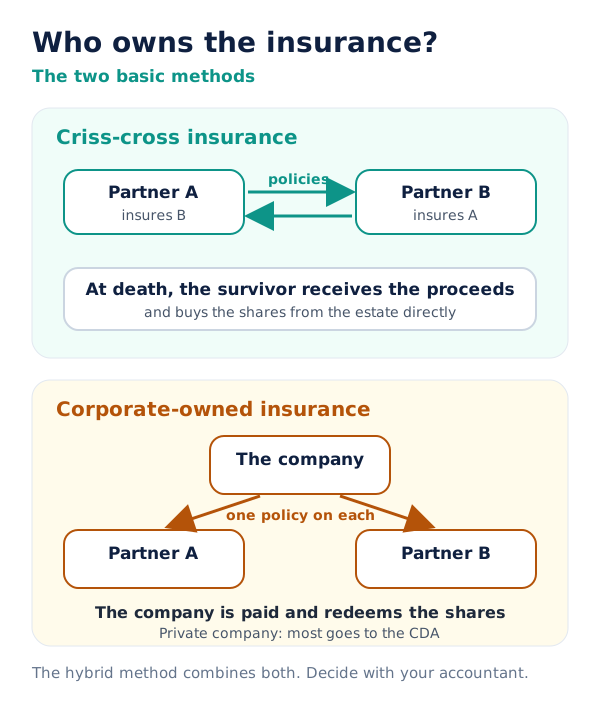
Criss-cross insurance
Each partner pays for a policy on the other's life. At death, the survivor receives the proceeds and buys the shares from the estate directly.
It is simple to understand with two partners. With three or four, the number of policies grows quickly.
Corporate-owned insurance
The company owns the policies, pays the premiums and receives the proceeds. It then redeems the deceased's shares.
The death benefit is generally tax-free for the company. For a private corporation, the net life insurance proceeds, generally the portion that exceeds the policy's adjusted cost basis, can be added to its capital dividend account (CDA), according to the CRA.
That cost basis depends on the policy and how long it has been in force. The insurer can provide it. When it is small, most of the proceeds can be added to the CDA. The calculation can involve other adjustments and should be confirmed with your accountant or tax specialist.
The company can then pay a capital dividend, which is tax-free for a shareholder resident in Canada. This requires a sufficient CDA balance and a tax election filed on time.
The hybrid method
When the company redeems the shares, the estate can, in some cases, carry back a capital loss to the deceased's final return. According to iA, stop-loss rules can reduce that loss when the estate receives a capital dividend.
The hybrid method partly addresses this. The survivor buys some of the shares, and the company redeems the rest. According to Canada Life (in French), it aims to reduce the effect of those rules and adds flexibility, since the buyout may happen many years from now.
The choice depends on your structure, your shares and your tax situation. The calculation is done with your accountant or tax specialist.
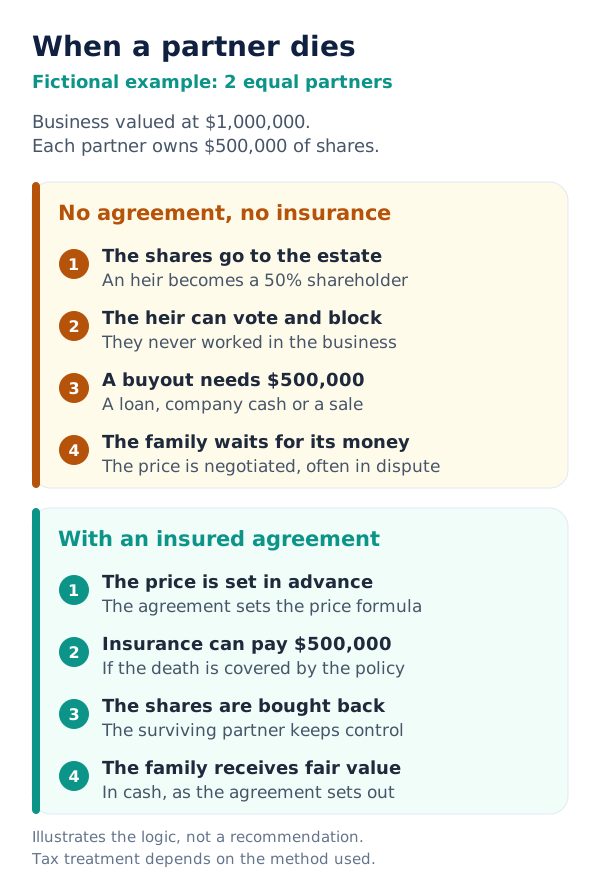
A worked example
Mark and Sophie (a fictional example) own a business valued at $1,000,000 in equal shares. Each holds $500,000 of shares. The example shows a purchase by Sophie, with criss-cross insurance that she owns and of which she is the beneficiary.
With no shareholders' agreement and no dedicated insurance, when Mark dies:
- his shares go to his estate, and an heir could become a 50% shareholder;
- to buy them back, Sophie has to find $500,000, at a price still to be negotiated;
- if tax is owed on the capital gain, the estate has to pay it without the cash from a sale.
With an insurance-funded agreement:
- the agreement sets the price and the valuation method;
- $500,000 of insurance is in force on each partner: if the death is covered and the contract's conditions are met, Sophie receives the planned proceeds to fund the purchase;
- the estate receives the agreed price in cash, and Sophie keeps control of the business.
The example shows the logic of the buyout, not a price or a recommendation. The real amount depends on the valuation of your business.
How much insurance do you need?
Enough to buy each partner's share at its current value. RBC Wealth Management recommends life and disability coverage large enough to fund the buyout of each shareholder's shares.
A common mistake among business owners, according to Alexandre: picking an amount at random, or settling for the minimum. That choice ignores business obligations, taxes and the succession plan.
To calculate the insurance need, Alexandre works from:
- the company's financial statements;
- the organization chart and how the shares are split;
- the valuation method set out in the agreement.
The value of the business and the tax impact of each structure are confirmed with your accountant or tax specialist.
Value changes over time. iA's guide recommends a valuation method adjusted every year, and an agreement reviewed whenever the shareholders' situation changes.
Back to Mark and Sophie. If the business grows from $1,000,000 to $2,000,000, each share is now worth $1,000,000. Insurance left at $500,000 leaves $500,000 to find.
What if a partner becomes disabled?
A disabled partner does not die, and life insurance pays nothing. Yet they no longer work and still own their shares.
Éducaloi notes that the agreement can provide for a forced sale in case of disability. That buyout still has to be funded.
Canada Life offers disability buy-sell insurance for a totally disabled partner, with a waiting period of one or two years before the buyout.
Other needs arise during time off work, separate from the share buyout. Corporate critical illness insurance pays an amount if the insured receives a diagnosis covered by the contract. Disability insurance helps replace income or pay expenses during the time off.

Retirement, separation, disagreement: the other triggers
Death is not the only event that forces a sale of shares. A good agreement covers these too.
| Event | Clause that covers it | How the buyout is funded |
|---|---|---|
| Retirement or withdrawal from the business | Mandatory offer to buy the shares | Company cash or staggered payments |
| Departure or sale to a third party | Right of first refusal | By the partner who buys |
| Serious disagreement between partners | Shotgun clause, mediation or arbitration | By the partner who buys |
| A partner's separation | Clause on the shares in a property division | Depends on the matrimonial regime |
Retirement. According to the Institut de planification financière (in French), a mandatory offer clause protects shareholders when one of them dies or withdraws from the business, with an automatic offer to buy their shares.
At retirement, life insurance pays nothing. RBC Wealth Management recommends that the agreement spell out how the buyout is funded: company cash, borrowing capacity or insurance. The earlier the buyout is planned, the less it weighs on the business.
Departure. A right of first refusal requires a partner who wants to sell to offer their shares to the others first, before a third party. The other shareholders thus get the chance to buy first. If they do not use it, a sale to a third party may be allowed under the terms of the agreement.
Disagreement. With a shotgun clause, one partner offers their shares to the others at a set price. The others must either buy at that price, or sell their own shares on the same terms. Éducaloi also notes that the agreement can call for mediation or arbitration instead of the courts.
Separation. The partnership of acquests, the default regime for married couples in Quebec since 1970, shares the value of property built up during the marriage. Depending on how they were acquired, shares can be part of that division. The agreement can set out what happens to the shares in that case: check it with your notary.
Five questions to ask about your agreement
Reread your agreement with these five questions. An uncertain answer points to something to clarify with the professional responsible.
- Does it provide for a share buyout at the death, disability and departure of a partner?
- Is the valuation method written down, and updated every year?
- Does the insured amount match the current value of each share?
- Who owns the policies, and is that consistent with who buys the shares?
- Is the agreement consistent with each partner's will?
Review your agreement with Alexandre

Alexandre Garneau, a financial security advisor representing iA Financial Group, handles the insurance side of your agreement:
- the amount needed to buy each partner's share;
- the structure of the policies: criss-cross, corporate-owned or hybrid;
- coverage if a partner becomes disabled;
- updating the amounts when the value of the business changes.
He works with your notary or lawyer on the agreement, and with your accountant on taxes.
The needs analysis is free, with no obligation to buy. It may lead to an insurance proposal, which you are free to decline. If you buy a policy, Alexandre is paid a commission by the insurer.
For all business coverage, see our corporate insurance page, corporate life insurance and our page for entrepreneurs.
This article provides general information. It is not tax or legal advice for your situation. The agreement is drafted with a lawyer or notary, and its tax treatment is confirmed with an accountant or tax specialist. Alexandre Garneau holds a certificate issued by the Autorité des marchés financiers (AMF), no. 272275. His professional conduct is overseen by the Chambre de l'assurance (Quebec's insurance professional body).