

Key takeaways
- Aim for 60% to 85% of your net available income.
- EI pays at most $729 a week, for 26 weeks.
- Registered under 12 months? EI's self-employed plan pays nothing.
- To insure: your expenses, minus income that lasts.
- You pay the premium: benefits generally tax-free.
"If your income stopped tomorrow morning because of an accident or an illness, how much would you need each month to pay the mortgage, your personal expenses and your business obligations?"
That is Alexandre's rule of thumb. The answer is the starting point for calculating disability insurance for self-employed workers.
In short: add up your fixed monthly expenses. Subtract only the income that would continue for the whole disability. Temporary help, such as EI, is better used to get through the elimination period. The gap is the need to protect, to be confirmed with the insurer.
In practice, Alexandre generally aims for income protection that replaces 60% to 85% of net available income, depending on real needs. Each insurer then sets its own cap.
Why self-employed disability insurance has to be calculated by hand
Because nobody does it for you. An employee often has group insurance, with an amount set by the employer.
A self-employed worker has no employer wage-loss plan. Group insurance can also be offered through a professional association or a union, as the Autorité des marchés financiers (in French) points out.
So start by checking the coverage you already have. If it is missing or not enough, it is up to you to assess the need for individual coverage.
The most common mistake Alexandre sees among entrepreneurs: picking an amount at random, or settling for the minimum.
That choice ignores personal expenses, business obligations and taxes.
According to Statistics Canada, 27% of Canadians aged 15 and older had at least one disability in 2022, up from 22% in 2017.
The agency attributes this increase partly to an aging population and to a sharp rise in mental health-related disabilities among youth and working-age adults.
What do public programs pay in 2026?
Not much, and only in specific cases. Each program covers a specific cause, for a limited time or under strict conditions.
| Program | Maximum it pays | The limit to know |
|---|---|---|
| EI sickness benefits (any illness or injury) | 55% of income, up to $729 a week in 2026, for up to 26 weeks | You must register at least 12 months before you apply, and meet other conditions |
| QPP disability pension (severe and permanent disability) | Up to $1,737.67 a month in 2026 | Before age 60, you must be unable to hold any full-time job, and have contributed enough |
| CNESST personal coverage (in French) (workplace accident) | Based on the insured amount you chose | Only if you bought it; no coverage for ordinary illness |
| SAAQ (in French) (road accident) | 90% of net income, on gross income of up to $102,500 | Does not cover illness |
For the QPP pension, other rules apply between ages 60 and 65. Retraite Québec explains them on the same page.
In other words, cancer, depression or back pain that is not work-related is covered neither by the CNESST nor by the SAAQ.
The two EI traps for self-employed workers
EI only helps if you registered in advance. According to Canada.ca, your agreement must have been in place for at least 12 months before you can receive benefits.
You must also have earned a minimum self-employment income the previous year ($9,254 in 2025 for a claim in 2026). And you must have reduced the time you spend on your business by more than 40%.
These conditions apply to the voluntary program for self-employed workers. If you also hold a salaried job, you may qualify for sickness benefits through your insurable hours (600 hours in the previous 52 weeks, according to Canada.ca).
Temporary good news: for claims that start from March 30, 2025, to October 9, 2027, the EI one-week waiting period is waived, according to Canada.ca. The time needed to process the claim is a separate matter.
The second trap is duration. Sickness benefits last 26 weeks at most, and a serious disability often lasts longer.
Once sickness benefits end, the QPP disability pension can take over if its conditions are met. It is reserved for severe and permanent disabilities.
The first payment normally arrives in the 4th month after the month the disability is recognized, according to Retraite Québec.
Depending on your income and assets, the Social Assistance or Social Solidarity Program (in French) may also apply. These programs are meant to cover basic needs.
How to calculate your disability insurance in three steps
Start from your real numbers, not from a percentage picked at random. Three steps are enough.

Step 1: your fixed expenses
Add up everything that must be paid even if you stop working:
- your mortgage or rent, property taxes and electricity;
- groceries, the car, insurance and your children's expenses;
- your business obligations: office space, software, liability insurance, professional dues, business loan.
Look at these business costs separately: depending on the eligible expenses and the contract, they may fall under business overhead expense insurance rather than your personal disability insurance.
As a benchmark, Quebec households spent an average of $65,344 on goods and services in 2023, or about $5,445 a month (Statistics Canada).
This average includes non-essential spending. It does not replace your own budget: work out your fixed expenses from your own statements.
Step 2: what you would actually receive, and for how long
Separate two kinds of amounts:
- Income that lasts, such as investment or rental income. Subtract it from your expenses.
- Temporary help, such as EI. It stops after 26 weeks at most. So it does not reduce your long-term need. It is better used to get through your contract's elimination period.
If your EI agreement has not been active for 12 months, or you do not have the minimum required income, count zero from this program. If you also hold a salaried job, check whether you qualify through that job.
Do not count on the QPP pension in advance: it depends on strict recognition. And if it is paid, contracts generally reduce disability insurance benefits, according to the AMF (in French).
Also compare after-tax amounts. EI benefits are taxable.
Step 3: the gap, within the contract limit
The gap is your estimated need. Alexandre then compares it with your net available income: he generally aims for 60% to 85% of that income. The insurer applies its own cap and decides whether to accept the application.
If a difference remains, it is covered by an emergency fund or by reduced spending during the time off. That fund also has to last through the elimination period.
To run the numbers with your own figures, download our calculator spreadsheet (Excel, works with Google Sheets and Numbers). It follows the three steps and uses 2026 amounts.
A worked example
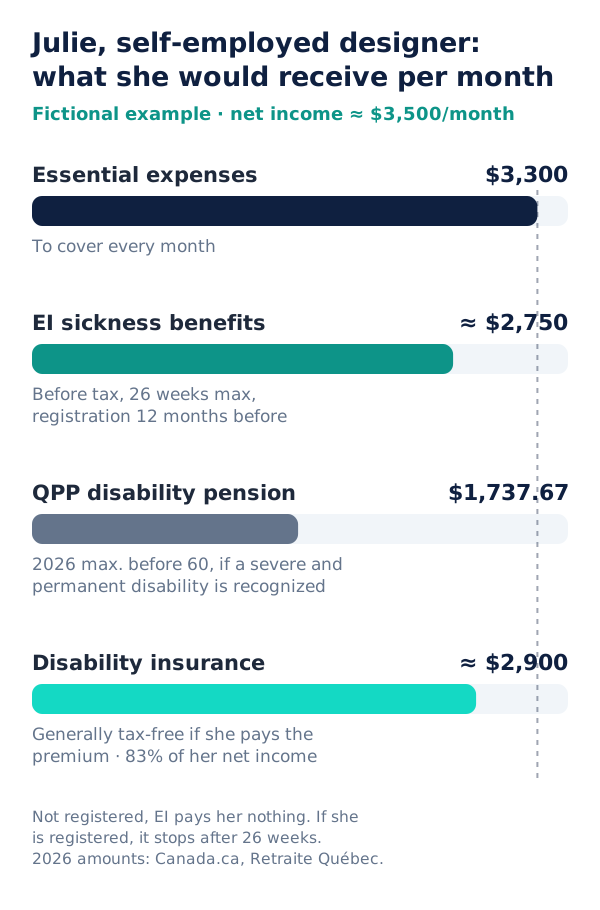
Julie (a fictional example) is a self-employed graphic designer. Her net business income is $60,000 a year before tax, or $5,000 a month.
After income tax and her QPP and QPIP contributions, she has about $3,500 a month left. That is her net available income (an estimate that varies with each person's situation).
| Julie's fixed expenses | Per month |
|---|---|
| Mortgage and property taxes | $1,300 |
| Personal and family expenses | $1,500 |
| Business obligations (software, office space, liability insurance) | $500 |
| Total needed | $3,300 |
Julie has no other income that would continue during time off. Her long-term need is therefore $3,300 a month.
Assume she has been registered for EI for more than 12 months, that her 2025 income was also $60,000 and that she meets all the conditions. She would receive about $635 a week before tax (55% of $60,000 divided by 52), or about $2,750 a month on average. But only for 26 weeks at most.
If she subtracted that amount from her expenses, she would insure only $550 a month ($3,300 minus $2,750). After 26 weeks, she would be short $2,750 every month.
Here instead is what she would receive, period by period. Assumptions for this example: a contract with a 90-day elimination period, benefits payable to age 65 (a fictional benefit period), and a premium paid by Julie.
| Period | Without private insurance | With $2,900 a month of disability insurance |
|---|---|---|
| Elimination period (about 3 months) | About $2,750 before tax if she is registered for EI. For a claim that starts by October 9, 2027, there is no EI waiting week. Otherwise, nothing from EI. | Same: the contract does not pay yet. |
| Up to week 26 | EI continues, if she qualifies. | The $2,900 begins. How EI affects it depends on the contract's coordination clause. |
| After 26 weeks | Nothing from EI. A QPP pension of up to $1,737.67 if the disability is recognized as severe and permanent, or social assistance depending on her resources. | $2,900, generally non-taxable, as long as Julie meets the conditions and up to the maximum benefit period in the contract. A QPP pension would generally reduce this benefit. |
What this means for Julie:
- A benefit of $2,900 a month represents 83% of her net available income ($2,900 out of $3,500). It falls within the range Alexandre aims for, from $2,100 to $2,975.
- Over the long term, $400 a month would remain to be covered ($3,300 minus $2,900), or $4,800 a year. An emergency fund does not solve this gap for good: she needs to identify the expenses she can really cut, or review the amount applied for.
- During the elimination period, without EI, her emergency fund must cover about $9,900 (3 months at $3,300). If she is registered, EI narrows that gap, but it is taxable.
The example shows the logic of the calculation, not a price or a recommendation. Your real numbers, your occupation, your health and the insurer you choose will change the result.
The three contract choices that change what you receive
The monthly amount is only one part of the protection. Three other choices decide what you will receive.
- Elimination periodThe elimination period (waiting period) is the time you wait without benefits, as Éducaloi (in French) points out. The longer it is, the lower the premium, and the longer your emergency fund has to last.
- Definition"Own occupation" protects you if you can no longer work in your specific occupation. "Any occupation" costs less, but sets stricter eligibility criteria (disability insurance). Also check whether the definition changes after a period set out in the contract.
- Benefit periodHow long benefits are paid varies from one contract to another. If your family depends on your income, this is a decisive choice.
Also read the coordination clause: it explains how public benefits reduce the contract's benefits.
Do you know how much you would receive, and how long you would wait for the first payment? Reread your contract before you need it.
Incorporated? Who pays the premium changes everything
If you pay your premiums yourself, disability benefits are generally non-taxable. That is what makes Julie's calculation so straightforward.
If your corporation pays the premium on an individual policy, the premium generally becomes a taxable benefit for you.
That is what the Canada Revenue Agency specifies. As a general rule, the benefits then remain non-taxable.
If the corporation instead funds a group wage-loss replacement plan, the benefits are generally taxable, as the AMF (in French) notes. You then need to insure a higher amount to keep the same net income.
These rules depend on your structure. Confirm your situation with your accountant or tax specialist.
For business owners, there is also disability insurance paid by the business. Its tax treatment depends on your situation.
What if the budget does not cover everything?
Start with the amount that protects the essentials: the roof over your head and basic expenses. Coverage can increase later, as your income grows, subject to the insurer's conditions.
Waiting can cost more. A health problem that appears in the meantime can lead to an extra premium or an exclusion.
Disability insurance also works alongside critical illness insurance. One can replace part of your income over time. The other can pay a lump sum when a covered illness meets the contract's conditions, including any survival period that applies (AMF, in French).
For all your coverage, see our self-employed workers page and our article on life insurance for self-employed workers.
Calculate your disability insurance with Alexandre

Alexandre Garneau, financial security advisor representing iA Financial Group, starts from your real numbers:
- your fixed personal and family expenses;
- your business obligations, and what happens to the business if you stop;
- your net income over the past few years;
- whether or not you are registered for EI;
- your structure: sole proprietor or incorporated.
From there, he prepares a proposal for the amount, elimination period and benefit period that fit your budget. Coverage remains subject to the insurer's acceptance.
The needs analysis is free and comes with no obligation. It may lead to an insurance proposal, which you are free to decline. If you buy a policy, Alexandre is paid a commission by the insurer.
This article provides general information. It does not replace tax or legal advice tailored to your situation. Public program amounts are those for 2026 and change every year. Alexandre Garneau is a self-employed financial security advisor. He represents iA Financial Group and also offers products from the MRa firm. He holds a certificate issued by the Autorité des marchés financiers (AMF), no. 272275. His professional conduct is governed by the Chambre de l'assurance (Quebec's insurance professional body).